
Reading BestOnlyFans Cards for Price Stability Clues
OnlyFans pricing is rarely static, and BestOnlyFans ranking cards exist partly to make those shifts visible before you subscribe. A creator’s monthly rate can move several times in a year, and because the platform stops auto-renewal the moment a creator raises the price, a subscriber who ignores pricing history can lose access without warning. Reading a ranking card properly means treating the price field as a timeline, not a snapshot.
Ranking cards pull together several observable data points: current price, historical price movement, renewal behaviour, and the page’s content model. None of these numbers tell you what a creator will charge next month, but patterns repeat often enough to be useful. This guide walks through each card element, explains what stable and unstable pricing look like, and shows how to track a page yourself.
Ranking Card Fundamentals
Ranking cards are structured summaries, not opinion pieces. Each card condenses a creator’s public pricing data and subscription model into fields a reader can scan in seconds. Because OnlyFans has no built-in discovery feed or directory, third-party ranking sites fill that gap by organising pages into comparable entries.
A typical card shows the current base subscription price, the historical range that price has moved within, and whether the page operates as free or paid. Paid subscriptions run from $4.99 at the minimum to $49.99 at the maximum, though most cluster between $5 and $10. Free pages list at $0 and earn through pay-per-view messages and tips instead.
- Current base subscription price and whether it is a promotional first-month rate
- Historical price range observed over the tracked period
- Number of recorded price changes
- Page type: free, paid, or mixed PPV model
- Last observed price update date
- Renewal status notes, including any auto-renew interruptions
The reliability of these fields depends on how often the underlying data is refreshed. A card updated monthly will miss a mid-month change, while one updated weekly catches more movement but still lags behind real-time. Treat every card as a snapshot with a timestamp attached.
Price History Visualization
Price history is where cards become genuinely informative. A single current price tells you what you would pay today; a history tells you how often that number moves. Cards usually present this as a short list of dated price points rather than a graph, which makes the duration between changes easy to read.
Duration matters more than the price itself. A creator who has held the same rate for twelve months signals a different business approach than one who has changed price three times in six months. The table below maps common historical patterns to their practical meaning.
| Time Period | Price Point | Signal Meaning |
|---|---|---|
| 12+ months unchanged | Same base rate throughout | Stable pricing, predictable renewal cost |
| 6-11 months unchanged | Single rate held | Generally stable, minor risk of adjustment |
| 3-5 months unchanged | Recent change recorded | Moderate volatility, watch the next update |
| 1-2 months unchanged | Frequent movement | High volatility, renewal cost uncertain |
| Under 30 days | New or promotional rate | Introductory pricing, expect a rise later |
Promotional pricing deserves separate attention. A first month at $3 is permitted even though the platform minimum for a base subscription is $4.99, because promotions sit outside the standard rate ladder. If a card shows a low introductory figure, check whether the listed price is the base rate or a temporary offer.
Stability Versus Volatility Signals
Stability is a pattern, not a guarantee. The clearest indicator is a long gap between recorded changes combined with a rate inside the typical $4.99 to $15 band. Pages in that range rarely need to reposition because the price already matches market expectations.
Volatility shows up in clusters. Two or more changes within a single quarter usually mean the creator is testing price points, responding to subscriber churn, or restructuring the page model entirely. Neither outcome is inherently bad, but both make your renewal cost harder to predict.
- Flat history with one entry per year: strong stability signal
- Stepped increases at long intervals: controlled growth, moderate stability
- Repeated small changes within months: active testing, low predictability
- Sharp jump followed by a drop: reactive pricing, treat cautiously
Watch the direction of change, not just the frequency. A page that has raised its price once in eighteen months is more predictable than one that has dropped and raised it three times in the same window.
Free pages complicate the picture because their $0 base rate never moves. Their real pricing lives in PPV messages, which unlock up to $50, and in paid chat that commonly runs $3 to $5 per message. A ranking card tracking only the subscription field will show a flat line for these pages even when spending patterns vary widely.
Platform Auto-Renew Mechanics
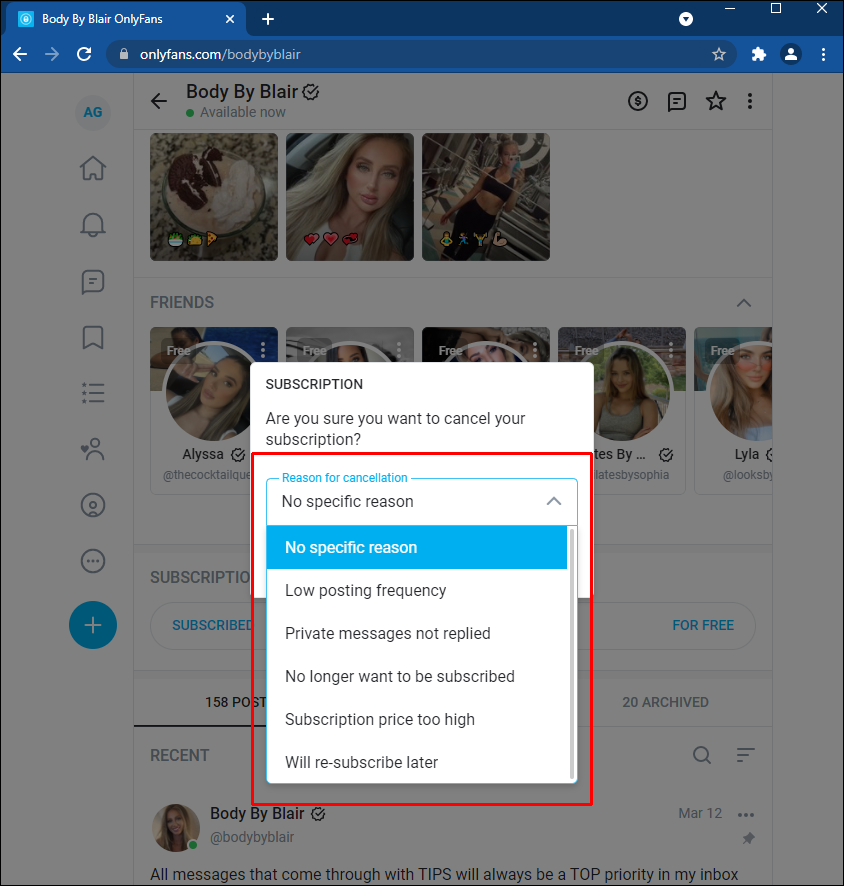
OnlyFans handles price changes in a specific way, and understanding the sequence prevents most renewal surprises. When a creator raises the price, auto-renew stops automatically. Your existing access continues until the paid period you already bought runs out, then the subscription lapses unless you act.
- Creator updates the base subscription price on their page
- Platform flags the change against all active auto-renew subscriptions
- Auto-renew is switched off for affected subscribers
- Current paid access continues until the existing period expires
- Subscriber must manually renew at the new rate to continue
This mechanic is why price history on a ranking card has practical value rather than academic interest. A page with frequent increases will repeatedly interrupt your auto-renewal, forcing a manual decision each time. A stable page renews quietly until you choose to cancel.
Lowering a price does not trigger the same interruption, so decreases are less disruptive but also less visible on cards that only log increases. Verification also matters here: the $0.10 card verification hold is refunded within days and is not a subscription charge, so it should never appear as a price point on a card.
Timing Subscriptions Around Price Shifts
Timing is about matching your commitment to a page’s pricing direction. If a card shows a long flat history, joining at any point carries roughly the same cost. If the history shows an upward trend, earlier entry locks in the lower rate for the period you purchase.
- Upward trend, long gaps between changes: join sooner to secure the current rate
- Flat history, rate within the $5-$10 cluster: timing is largely irrelevant
- Recent volatility with mixed direction: wait one billing cycle and recheck the card
The opposite logic applies to pages that have recently dropped their price. Joining immediately captures the lower rate, but if the drop looks like a test, the rate may return to its previous level. Neither approach removes uncertainty; both reduce the size of the surprise.
One more consideration: promotional first months below $4.99 are common entry points. If you subscribe during a promotion, plan for the standard base rate at renewal, because the discounted figure is temporary by design.
Cross-Referencing Multiple Data Points
No single card field is authoritative. Cross-referencing turns a rough signal into a defensible judgement, and the process is straightforward once you know which fields to compare.
- Compare the card’s last update date against today’s date to gauge staleness
- Check the current price on the creator’s page against the card’s latest entry
- Review the historical range for gaps that suggest missing data
- Confirm whether the page is free or paid, since the models behave differently
- Note any renewal interruption flags and match them to dated price changes
Discrepancies are normal and usually explainable. A card may lag by days, or a promotion may have started after the last refresh. Persistent mismatches, however, suggest the card is not being maintained and its history should carry less weight in your decision. When a page lists a subscription inside the standard $4.99 to $49.99 range, that figure is verifiable directly, which makes it the strongest single check available. Readers comparing multiple creators often start with curated roundups such as best onlyfans men before drilling into individual cards.
Building a Personal Price Tracking System
A personal log beats relying on memory, and it does not need to be elaborate. The goal is a dated record of what you actually paid and what the card showed at the time, so future changes become visible rather than surprising.
| Tracking Method | Effort Level | Reliability |
|---|---|---|
| Manual notes app entry | Low | Moderate, easy to forget |
| Spreadsheet with dated rows | Medium | High, sortable and comparable |
| Calendar reminders to recheck | Low | Moderate, depends on follow-through |
| Third-party price alerts | Low | Variable, coverage is incomplete |
A spreadsheet works best because it forces a fixed format: date, listed price, page type, and whether auto-renew was active. Four columns are enough. After three or four entries, your own data starts to reveal the same stability patterns the ranking cards describe.
Treat any unexpected charge with scrutiny. If a price change or renewal does not match your log, verify it against your account history before acting, and review general guidance on chargeback procedures so you understand how disputes are handled if an error is confirmed.

FAQ
How often does BestOnlyFans update its price history data?
Refresh frequency varies by card and is usually stated alongside the last update date. Some entries are revised weekly, others monthly. Always check the timestamp before treating a price point as current, and verify against the creator’s page for anything time-sensitive.
What does a flat price history line indicate about a creator’s business approach?
A flat line means the base rate has not changed across the tracked window. In practice it suggests a settled pricing strategy and a predictable renewal cost, though it says nothing about PPV or tip spending, which sit outside the subscription field.
If auto-renew stops due to a price increase, can I manually renew at the new rate?
Yes. Access continues until your paid period ends, and you can then renew manually at the updated price. Your subscription simply will not continue automatically until you take that step.
Why might BestOnlyFans show different prices than what I see on OnlyFans?
Timing is the usual reason. A promotion may have started or ended after the card was last refreshed, or the card may be tracking the standard base rate while the page currently shows an introductory offer. Compare update dates before assuming an error.